How Grit is Connected to Student Success in the Math Classroom
India White • June 22, 2023
How Grit is Connected to Student Success in the Math Classroom

How Grit is Connected to Success in the Math Classroom- Dr. India White
Grit is a term that has been gaining popularity in the education world. It refers to the ability to persevere through challenges and setbacks, and it has been linked to success in many areas, including math. Grit is the ability to pushback against various obstacles faced in life. In fact, research has shown that students who exhibit grit are more likely to succeed in math class than those who do not. In this blog, we will explore the connection between grit and success in math and provide eight tips for teachers to help their students succeed through grit.
The Connection Between Grit and Success in Math
Research has shown that grit is a key factor in success in math. A study conducted by Duckworth and colleagues (2007) found that students who exhibited more grit were more likely to earn higher grades in math class. Another study by Credé and colleagues (2016) found that grit was a better predictor of math achievement than IQ or conscientiousness. Grit has been the key determinant factor in success for students from all backgrounds experiencing various life struggles.
So, why is grit so critical for success in math? One reason is that math is a subject that requires persistence and perseverance more than other subject areas due to the need to retain previous skills and prior knowledge. Students who give up easily when faced with a difficult math problem are less likely to succeed than those who keep persisting through productive struggle. Additionally, math is a subject that builds on its content. If a student struggles with a concept early on and gives up, they may have difficulty understanding more advanced concepts later on.
Tips for Helping Students Succeed Through Grit in Math
As an educator, there are several things you can do in your classroom to help your students develop grit and succeed in math. Here are eight tips to get you started:
1. Set high expectations:
Research has shown that when teachers set high expectations for their students, those students are more likely to succeed (Rosenthal & Jacobson, 1968). Students will usually rise to the occasion and at times surpass expectations set by their teachers. As you give students the ability to try at challenging math, this can contribute to a decrease in the opportunity gap and can allow students who lack confidence to establish a stronger voice in their math class while solidifying their math identity. Let your students know that you believe in them and that you expect them to work hard and succeed in math.
2. Teach a gritty and growth mindset and way of work: Help your students develop a growth and gritty mindset by teaching them that their abilities can be developed through hard work and dedication (Dweck, 2006; Duckworth, 2016). Encourage them to embrace challenges and view mistakes as opportunities to learn. As students are discouraged through mistakes made during math practice, remind them to harness G.R.I.T. (great resilience in time) and to refocus and try again, keeping in mind prior knowledge and nuggets of wisdom given throughout instruction.
3. Provide feedback:
Give your students feedback
on their work that is specific, timely, and actionable (Hattie & Timperley, 2007). Let them know what they did well and what they can improve on and provide suggestions for how they can improve. When providing feedback, be specific on what they did correctly, i.e., “I like how you were attending to precision on problem 8, and how you were able to factor that polynomial thoroughly, etc.” Students want to hear more than,” Good job”. When you take the time to be intentional at feedback, it helps students navigate with more clarity and assurance that they are on the right track and can strengthen their math ability
and reasoning as they work through with a gritty mindset through the math.
4. Encourage self-reflection:
Encourage your students to reflect on their own learning and progress. Ask them to think about what they have learned, what they still need to work on, and what strategies have been most effective for them. Some ways you can do this can be through providing a math journal for students to reflect during the last 5 to 10 minutes of class. You can provide (KWL) charts
or have a whole class discussion at the end where students can gather their desks in a circle and share-out their thoughts while remaining respectful and remembering class norms.
5. Use RELEVANT real-world examples:
Help your students see the relevance of math by using real-world examples and applications. Show them how math is used in everyday life and in different careers. Further, be intentional at providing lessons that are culturally responsive
so that students from various backgrounds can see themselves in the math. This helps increase engagement and can make learning fun in the math classroom.
6. Allow Discussion:
Encourage your students to work together and collaborate on math problems. This can help them develop problem-solving skills and learn from each other. It’s through discussion during mathematical discourse that higher order thinking occurs, and students experience metacognition that leads to conceptual understanding.
It helps students to think with clarity
as they think about their thinking, giving them the confidence needed to stand on their own reasoning as independent math students.
7. Celebrate progress:
Celebrate your students' progress and successes in math.
This can help them stay motivated and continue to work hard. Students thrive off compliments, and progress made while learning in class. Further, complimenting students helps strengthen relationships between students and their teacher, and is essential for student engagement and motivation.
8. Show them Grit in Action:
Finally, model and foster grit for your students. Let them see you persevering through challenges and setbacks, and show them that you believe in the power of hard work and dedication. Encourage them to tap into their grit as you model moments of resilience during instructional delivery with your students.
Conclusion
Grit is a key factor in success in math, and as a teacher, there are many things you can do to help your students develop grit and succeed in math. By setting high expectations, teaching growth mindset, providing feedback, encouraging self-reflection, using real-world examples, providing opportunities for collaboration, celebrating progress, and modeling grit, you can help your students develop the persistence and perseverance they need to succeed in math and in life.
References:
Credé, M., Tynan, M. C., & Harms, P. D. (2016). Much ado about grit: A meta-analytic synthesis of the grit literature. Journal of Personality and Social Psychology, 113(3), 492–511. https://doi.org/10.1037/pspp0000102
Duckworth, A. L., Peterson, C., Matthews, M. D., & Kelly, D. R. (2007). Grit: Perseverance and passion for long-term goals. Journal of Personality and Social Psychology, 92(6), 1087–1101. https://doi.org/10.1037/0022-3514.92.6.1087
Dweck, C. S. (2006). Mindset: The new psychology of success. Random House.
Hattie, J., & Timperley, H. (2007). The power of feedback. Review of Educational Research, 77(1), 81–112. https://doi.org/10.3102/003465430298487
Let's Connect!




Grateful for GRIT Games!

Excited to Speak at FCTM!!
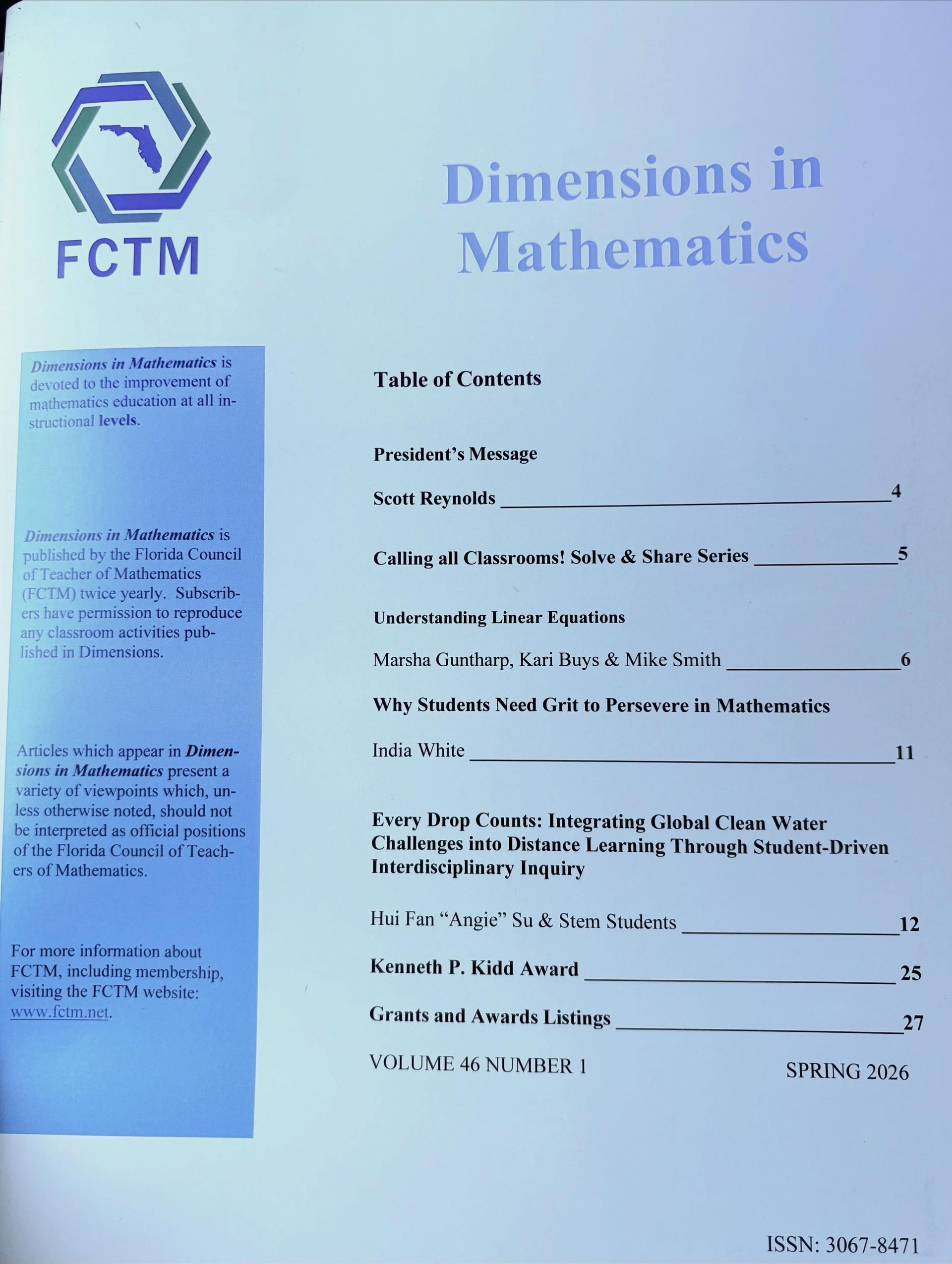
Grateful for the FCTM Dimensions Feature!

Check out my June Newsletter!

It's Time for a Reset!

Gritty Tips for Moms!

May Newsletter is Here!

Grateful for Degree # 4- M.A.

Gritty to the Finish Line!
🌸✨ Happy April, G.R.I.T. Family! ✨🌸 I’m so excited to share that my April Newsletter is officially LIVE! 🙌🏽📬 This month is filled with growth, gratitude, and powerful momentum, and I couldn’t wait to bring you along on the journey! 💫 🎉 Inside this month’s newsletter: ✨ A special feature with Ultimate Medical Academy and the impactful work we’re doing with universities to build G.R.I.T. in students and leaders 🎓 Celebrating a personal milestone; I’ve completed my Master’s in Christian Leadership! 🎤 Speaking engagements (including the Atlanta Math Conference 👀) 📚 Ways we’re continuing to support students and educators through the G.R.I.T. Framework This season is all about growth, purpose, and impact—and I’m more energized than ever to continue leading leaders nationwide and building strong character through G.R.I.T. 💪🏽🌱 💼 Let’s Partner! I’m currently booking: 🎤 Speaking engagements 📚 G.R.I.T. Academy tutoring 🎯 Consulting services for schools, districts, and universities If you’re ready to bring the G.R.I.T. Movement to your organization, let’s connect! 📩 indiawhiteconsulting@gmail.com Let’s keep growing. Let’s keep leading. Let’s stay G.R.I.T.T.Y.! 💥🔥📚 hashtag#DrIndiaWhite hashtag#GRITMovement hashtag#Leadership hashtag#Education hashtag#NewsletterLaunch hashtag#GrowthMindset hashtag#Resilience hashtag#ChristianLeadership hashtag#LetsGetGritty hashtag#nctm hashtag#ncsm hashtag#bwxme hashtag#n